
Imagine you’re in a coffee shop in Portland, about to move a mixed portfolio of Bitcoin, Monero, Litecoin and a few ERC?20 tokens between devices. You want two things: (1) strong privacy so your on?chain choices don’t leak into a profile that can be stitched together later, and (2) practical multi?asset tooling so you don’t need five separate apps. That concrete moment frames the trade-offs this article unpacks: what privacy actually means at the wallet level, which mechanisms produce it, where those mechanisms fail, and which users should favor which design choices.
Below I compare the mechanism-level architecture and trade-offs behind a privacy-first, multi-currency wallet such as cake wallet against the alternatives that users commonly consider: single-asset privacy-native clients (for example, Monero GUI), mainstream multi-asset wallets, and hardware-only solutions. The goal is to turn high?level slogans (private, non-custodial, open-source) into decision-useful rules of thumb you can reuse tomorrow.
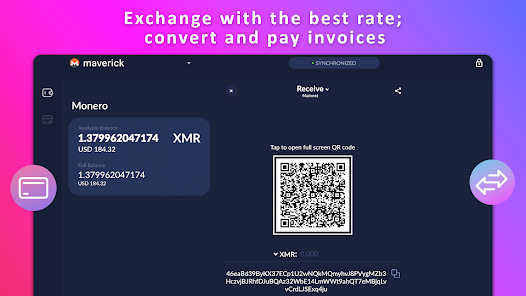
Core mechanisms that create privacy — and what they actually protect
Privacy means different things depending on which link you break: the link between identity and on?chain addresses, the link between transactions, or the link between network traffic and a user’s IP. A robust wallet treats all three. Mechanisms to watch for and how they work in practice:
– Key custody and non?custodial design: if a wallet never sends your private keys off device and is open?source, you control signing and key storage. That prevents centralized server compromise but does not protect against local device compromise (malware, physical coercion). Cake Wallet is non?custodial and open?source, which shifts trust from the company to your operational security.
– Device-level encryption and secure authentication: storing the wallet seed and keys in hardware-protected areas such as the Secure Enclave (iOS) or TPM (Android) reduces the risk the keys are extracted if the device is compromised. Cakes’ approach of protecting access with a 4?6 digit PIN plus biometric unlock leverages that hardware; it is effective, but limited by the legal and physical threat model — a compelled user might still reveal a PIN or be forced to unlock biometrics.
– Protocol-native privacy (Monero, Zcash, MWEB): native privacy coins offer privacy by design — Monero through ring signatures and stealth addresses, Zcash through shielded transactions, MWEB for Litecoin via confidential transaction techniques. A multi?currency wallet that preserves the native privacy primitives (e.g., Monero with background sync and local private view key retention; Zcash enforcing outgoing shielding) avoids the common pitfall of degrading a privacy coin into a transparent instrument through poor wallet defaults. Cake Wallet’s default of mandatory ZEC shielding is an example of a sensible safeguard: it prevents accidental transparent spends.
– Bitcoin privacy tooling: Bitcoin is not private by default. Wallets approximate privacy using protocol?level techniques like PayJoin v2 (PJ v2), Silent Payments, fine?grained UTXO control, and batching. These tools reduce some address reuse and linkage signals, but they do not make BTC indistinguishable like Monero does. The combination matters: selective UTXO control plus PayJoin helps, but an adversary with broad blockchain surveillance and network metadata can still deanonymize many users.
– Network anonymity: Tor-only mode and I2P proxy support obfuscate IP-level correlations. They reduce the risk that a node operator or ISP can tie your transactions to an IP. Crucially, network anonymity does not change on?chain linkages — it only severs network-to-transaction linkage when properly configured. Allowing custom nodes is a pragmatic option for advanced users who run their own nodes and want the strongest possible decentralization of trust.
Trade-offs: convenience, composability, and where privacy frays
Privacy is a multi-dimensional budget: improving one axis often compromises another. Here are the common trade-offs you will face with a multi-asset privacy wallet compared with single?asset privacy clients or hardware-only stacks.
– Convenience versus maximal isolation. Integrated swapping and built?in exchanges (swaps via NEAR Intents, or internal swap flows) let you move between XMR, BTC, ETH without sending coins to an external service. That increases operational privacy because you avoid third?party custodians. But any swap requires counterparty discovery and settlement; decentralized routing mitigates custodian risk but still creates on?chain interactions that can be correlated by a determined observer.
– Cross?chain privacy vs protocol guarantees. Native privacy coins (Monero, shielded ZEC, MWEB LTC) provide strong, protocol-level obfuscation. When you swap from a private coin to Bitcoin, you create an exit point where privacy guarantees tighten. How the wallet performs that swap (whether it batches, uses PayJoin, or leverages NEAR Intents to route through opaque makers) changes the effective privacy of the whole operation. There is no magic: cross-chain bridges are points of reduced entropy.
– Hardware integration: connecting a Ledger or an air?gapped Cupcake device keeps the private keys off a general-purpose phone, raising security. The trade-off is usability: routine operations become slower and sometimes incompatible with network anonymity settings. Hardware confirmation is best practice for high-value accounts, but for frequent small transactions it feels burdensome.
– Multi-platform reach vs consistent privacy defaults. Supporting iOS, Android, desktop requires reconciling different OS security models. While device-level encryption exists across platforms (Secure Enclave, TPM), implementations and platform policies differ. A wallet that works everywhere must avoid “weakest common denominator” defaults; Cake Wallet’s policy of keeping private view keys on-device and a no-telemetry stance are choices that favor privacy across platforms, but users should validate settings after installing on a new OS.
Where systems break: practical boundary conditions and limits
No wallet is a magic bullet. Three boundary conditions matter most for users in the United States or other adversarial environments:
– Local device compromise remains the top practical risk. If an attacker has persistent access to your phone or desktop, hardware protections raise the bar but don’t guarantee safety. Use full-disk encryption, secure boot where available, and consider air?gapped storage for very large holdings.
– Cross?chain and exchange operations leak. Anytime you convert between privacy primitives and transparent chains, a data point exists that can be used to probabilistically link histories. That leakage is not eliminated by decentralized routing; it is reduced but still present. Design your operational hygiene (use distinct addresses, delay between operations, chain of custody thinking) accordingly.
– Legal and coercive risks. Security mechanisms protect against remote adversaries but say less about lawful access compelled by subpoena or physical coercion. In the US context, legal disclosure rules and device-search practices vary; technical privacy does not replace legal counsel or institutional protections when those risks are material.
Comparative scenarios — which wallet pattern fits which user
Below are three common user profiles and the wallet configuration patterns that best match their priorities.
– The privacy-first, multi-asset daily user: wants quick swaps, Monero and BTC, and plausible deniability for low-value flows. Use a multi?currency privacy wallet with Tor-only mode, mandatory shielding for ZEC, MWEB enabled for LTC, and default PayJoin on BTC. Keep medium-sized balances on a hardware-backed profile and enable subaddresses to avoid address reuse.
– The technical maximalist: runs full nodes, wants verifiable independence. Use dedicated single?asset native clients (Monero GUI, a full Bitcoin node) with your own node endpoints, and use a hardware wallet for signing. Multi?asset convenience is sacrificed for stronger separation of attack surfaces.
– The custody?averse investor with infrequent moves: prioritize hardware-based air?gapped signing plus occasional on?device viewing. Use integrated swaps sparingly; when swapping, prefer decentralized, routed methods and accept the temporary privacy contraction at the swap boundary.
Decision-useful heuristics and a quick checklist
Two mental models and a short checklist will make future choices faster and less error-prone.
– Mental model 1 — “Three links”: (1) key-to-identity (custody), (2) transaction-to-transaction (on?chain linkage), (3) network-to-transaction (IP leaks). Ask how a wallet addresses each.
– Mental model 2 — “Entropy flow”: privacy is entropy. Every conversion or aggregation reduces entropy; preserving entropy means avoiding unnecessary joins, using subaddresses, and separating roles (saving receipts on an offline device, using distinct wallet instances for different purposes).
Checklist before moving funds: enable device encryption and secure enclave features; run the wallet in Tor-only or I2P mode when possible; prefer local node or vetted custom nodes; enable protocol-native privacy features (mandatory shielding, MWEB) and use PayJoin/UTXO control for BTC; integrate hardware signing for large balances.
What to watch next — signals that would change the calculus
Three developments would materially alter recommendations in the near term:
– Broader adoption of protocol-level privacy extensions for UTXO chains (wider MWEB-like adoption or stronger on?chain mixing standards) would reduce the current hybrid-fragility of cross-chain swaps.
– Improved decentralized swap primitives with atomic privacy guarantees (if they emerged) would lower the privacy cost of moving between privacy coins and transparent chains; today, NEAR Intents reduces counterparty risk but does not eliminate leakage.
– Platform policy changes that restrict Tor/I2P or tighten app store rules could force wallets to change network models; multi-platform wallets that already support custom nodes and multiple distribution channels (F?Droid, direct APK) are more resilient to such policy shifts.
FAQ
Q: If I use a multi?currency wallet that supports Monero and Bitcoin, do I get Monero-level privacy for my Bitcoin?
A: No. Privacy guarantees are protocol-specific. Monero’s privacy is built into the currency design; Bitcoin’s privacy is not. A multi?currency wallet can apply best practices (PayJoin, UTXO control, Silent Payments) to improve Bitcoin privacy, but it cannot make Bitcoin indistinguishable in the same way Monero is. Expect a privacy contraction whenever you move value between privacy and non?privacy chains.
Q: Does running the wallet in Tor-only mode make on?chain analysis useless?
A: Tor obscures network metadata and makes it harder to tie transactions to IP addresses, which is important. It does not change on?chain linkages or stop blockchain analytic firms from connecting transactions through heuristic methods. Tor reduces one class of risk but should be used together with strong on?chain hygiene.
Q: How important is hardware wallet integration for privacy?
A: Hardware wallets raise the security bar by keeping signing keys offline. This strengthens custody but doesn’t by itself improve on?chain privacy. Combining hardware wallets with privacy-preserving wallet software (that enforces shielding, uses subaddresses, and offers PayJoin) gives both better security and better operational privacy.
Q: Are built?in swaps safe from a privacy perspective?
A: Built?in swaps reduce exposure to external custodians and can use decentralized routing to find competitive rates, which helps. However, swaps still create transactional junctions that can be analyzed. Use decentralized routing options and delay/obfuscation techniques where feasible if privacy is the priority.